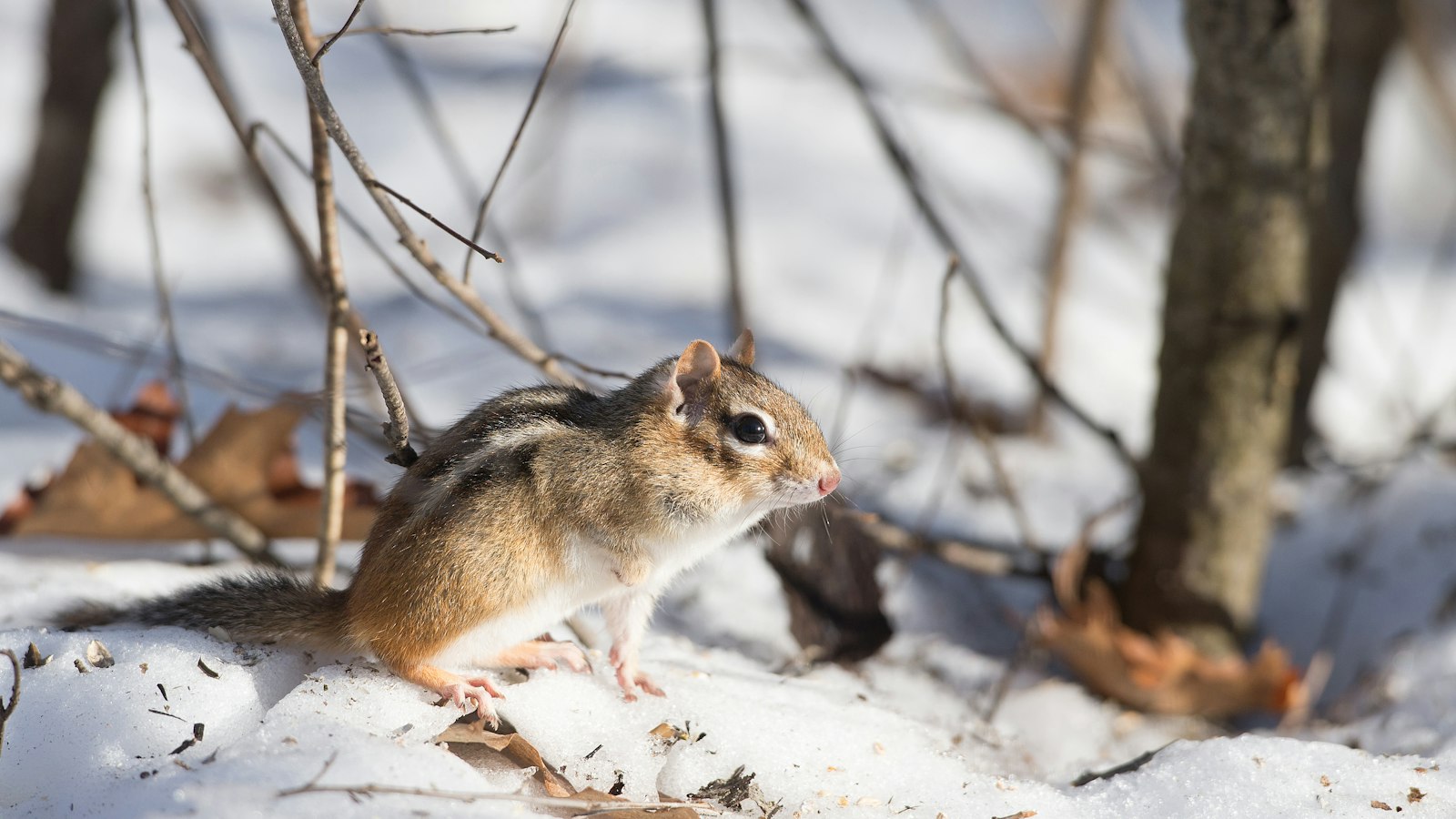
Every November we get the same call, and it is usually a relieved one. The chipmunks that were running the retaining wall all September have gone quiet, the holes by the patio have not been touched in two weeks, and the homeowner wants to know whether the problem solved itself for the winter. Sometimes they are already planning to fill the holes in.
I understand why it looks that way, and it is the most common wrong read we hear about this animal. A quiet yard in December does not mean an empty burrow. It means the animal stopped coming up as often, which is a different thing entirely, and knowing the difference changes when you deal with it and how well the fix holds.
Key takeaways
- Chipmunks do not truly hibernate. They drop into torpor for a few days at a stretch, then wake, eat from food stored in the burrow, and go back under. They survive on a larder, not on body fat, which is why they cannot sleep straight through the way a groundhog does.
- Expect to see one above ground on mild winter days. Tracks in fresh snow leading to a hole are normal, not a sign of a new problem.
- The burrow stays occupied and workable all winter, which is why a fall or winter job holds instead of being undone by the next animal moving in.
- Most wild chipmunks live two to three years. The ones wrecking your patio base are not a long dynasty, they are a territory that keeps getting refilled.
- Trapping is mechanical, with no poisons and no chemicals, so the yard stays safe for kids and pets while the work gets done.
Do Chipmunks Hibernate?
No, not in the true sense. Chipmunks are intermittent hibernators. They enter torpor for several days at a time, with body temperature and heart rate dropping sharply, then wake inside the burrow to eat from stored food before going back under. The burrow stays occupied all winter and they surface on mild days.
The word hibernation hides a real split in how animals get through a northern winter. One group commits. A groundhog spends late summer eating itself heavy, goes down in October, and runs its body almost to a stop until February. It does not keep a pantry because it is the pantry. Chipmunks took the other road. They do not put on the fat load that would carry them to March and would not survive trying, so they haul food instead, which is what all that cheek pouch work in September and October actually is.
So the bouts are short. In a torpor bout the chipmunk curls in its nest chamber and lets itself cool, with breathing and heart rate dropping to almost nothing you could measure from the outside. Then, every few days, it warms itself back up, which is expensive, eats from the cache a few feet away, and goes back down. The waking is not a flaw in the system, it is the system, and it is why the food store has to be there.
That has a practical consequence. An animal that wakes up regularly still has to surface sometimes, still defends a territory, and is still sitting under your steps in February.
Where Do Chipmunks Go in the Winter?
Straight down into the same burrow they used all year. The system runs about 3 feet deep and 10 to 30 feet long, with a nest chamber, separate chambers for stored food, and dead end escape shafts. Three feet puts the nest below our frost line, which is what makes an Ohio Valley winter survivable underground.
Nothing migrates and nothing relocates. The burrow you have been looking at since August is the winter quarters, which means the problem has an address.
The layout underneath is more organized than people expect: a nesting chamber lined with leaves and shredded material, one or more larder chambers packed with seed and nuts, blind tunnels that dead end as escape routes, and in many burrows a separate chamber used for waste so the nest stays clean. Entrances get plugged or allowed to drift shut when the weather turns hard, which is part of why the yard looks abandoned.
Placement matters as much as depth, and it is where the animal and the homeowner come into conflict. Chipmunks want a solid roof over the entrance, so they tuck burrows against a foundation, under a patio slab, beside a walk, behind a retaining wall, under the bottom step. The structure that makes the burrow safe from a fox is your structure. We walked through the identification side of this in what chipmunk holes look like.
Do Chipmunks Come Out in the Winter?
Yes, on mild days. A thaw, a stretch of sun, or a warm front in January will bring chipmunks to the surface for short trips. You may see one on bare ground or crossing snow, and you may find small tracks running to a single hole. Activity picks up sharply in late February as the breeding season starts.
Winter activity is not steady. It comes in bursts tied to the weather, and in our area a 50 degree afternoon in January is enough. The animal is already awake between torpor bouts, so a mild spell is a cheap chance to check the territory or move something.
Fresh snow is the best tool a homeowner has for this, and it costs nothing. The morning after a light snow, walk the foundation line, the patio edge and the base of any retaining wall. Chipmunk tracks are small, paired, and they run with purpose, usually in a short line from cover to a single opening where warm air has kept the entrance clear. One set of tracks going to one hole tells you more about what is living under your steps than three months of summer guessing did, because in December there is nothing else out there to confuse it with. What you should not read into it is a new arrival. A chipmunk on the snow in January is almost always the resident, out for an hour.
What Do Chipmunks Eat All Winter?
Stored food, almost entirely. Chipmunks spend late summer and fall hauling seed, acorns, beechnuts and other hard mast into larder chambers in the burrow, then eat from that cache through the winter between torpor bouts. A bird feeder or spilled seed in the yard lets them build a much larger store than the yard would otherwise support.
A chipmunk is a larder hoarder. It does not scatter caches across the yard and hope to find them later the way a gray squirrel does. It concentrates everything in the burrow, where it can reach the food without going out in the cold.
The size of that store is the part homeowners can influence. Chipmunks carry whatever is cheapest and closest, and almost every property we visit has a cheap, close source: a bird feeder, the spill underneath it, a bag of birdseed in the garage, grass seed, bulbs waiting to go in the ground, pet food left out on a patio. A well stocked feeder running through October means every chipmunk on the property goes into winter with a full pantry. Moving the feeders, cleaning up the spill and getting seed and bulbs into metal or hard plastic with a locking lid will not empty a burrow this winter, but it changes how many animals the yard can carry next year.
What does not work is poison, and we do not use it. It does nothing to the burrow system, it leaves a dead animal in a void you cannot reach, and it puts a poisoned animal in a yard where a dog, a cat or a hawk can get to it. The same goes for the repellent spikes and ultrasonic devices sold for this: the animal gets used to them within days, and it has a food store three feet underground that it is not abandoning over a noise.
How Long Do Chipmunks Live?
Most wild chipmunks live two to three years. A well situated adult can reach five or more, and captive animals have lived far longer, but mortality in the first year is heavy. The practical point for a homeowner is that the animal is short lived while the burrow and the territory are not.
People hear two to three years and assume the problem is self solving. It is not, and the reason is the difference between an animal and a vacancy.
Chipmunks are territorial and solitary outside of breeding. An adult holds a patch of ground with a burrow in it and chases others off. When that animal dies, the burrow does not fill in and the food and cover that made the spot good do not change, so the patch is attractive and empty at the same time. Juveniles dispersing in spring and again in late summer are looking for exactly that, and the vacancy usually fills within weeks. That is why a yard can look like it has had the same chipmunk for a decade when it has had five or six in a row, and why we treat trapping and exclusion as one job.
Breeding runs on the same calendar. Eastern chipmunks mate in late winter, usually from late February, and again in midsummer, with litters of around three to five. The first litter is dispersing by late spring, which is why a yard that had one chipmunk in February can look like it has six in June.
Does a Chipmunk Problem Go Away Over the Winter?
No. The animal is still in the burrow under your patio or steps, the tunnels are still undermining whatever sits on top of them, and the territory is still held. Winter quiet is reduced surface activity, not an empty yard. Filling the holes in December accomplishes nothing except destroying the information you need.
Here is what we actually see when a homeowner waits. The holes go quiet in November, they get filled in over a weekend, and by late March there are fresh openings within a foot or two of the old ones plus a couple of new ones. Nothing underground was touched. A chipmunk reopens a plugged entrance in minutes, and if the plug is stubborn it pushes a new shaft up alongside it. Worse, the yard is now unreadable: you can no longer tell which entrances are active, which is the first thing anybody working the property needs to know.
The structural side keeps running too, and it runs fastest in the months people assume are dormant. Water gets into the voids along a slab or behind a wall, freezes, expands and thaws, over and over, and that cycle is what turns a tunnel into a settled corner of a patio or a wall that starts to bulge. A network under a walk, a stoop or a poured porch is worth handling before spring, not after.
If the noise is inside the structure rather than under the yard, that is a related but separate job. Chipmunks work low, so a wall void, a rim joist, a crawl space or a garage ceiling are the usual spots, and we covered it in chipmunk in the house. Never seal an entry with the animal still inside.
Can You Trap Chipmunks in the Winter?
Yes, and winter has real advantages. The animal is tied to one burrow and one food store, nothing is dispersing, and no new chipmunks are moving in until spring, so the result holds instead of being filled by the next arrival. Activity is slower, so the work takes patience and accurate placement rather than volume.
Every job here opens with an inspection, in January the same as in July. We walk the foundation, the patio edge, the steps and the base of the retaining wall, and we find the entrances actually in use rather than guessing from a list of holes. In winter that read is easier, not harder: open entrances stand out in snow or frost because the air coming up keeps them clear, and tracks show the routes. Then we set at the active points and stay with it until the activity stops. It is mechanical work with no poisons and no chemicals, which is why the yard stays safe for kids and pets while it is going on. The slower season means fewer catches per day and more days, and we say so up front.
The payoff is the timing. Clear a burrow in winter and you are clearing it ahead of the late February breeding season and the spring dispersal, in the one window of the year when the vacancy will not be filled from outside within a few weeks. Pair that with the exclusion work, quarter inch hardware cloth or metal at every ground level gap, barriers that go into the ground and turn outward in an L at a deck or porch, mulch pulled back off the foundation, and you go into spring with a property that is no longer worth claiming.
We handle chipmunk removal in Cincinnati alongside moles, voles, squirrels, groundhogs and raccoons, across the Cincinnati area and the surrounding communities in Ohio, Northern Kentucky and southeast Indiana. If the mounds in your lawn are a different problem entirely, moles do not hibernate either.
If you have holes along a foundation or a patio and you are not sure whether anything is still using them, call (513) 518-5639 and tell us what you are seeing. We are in Monday through Friday, 8 AM to 6 PM Eastern. You can get a free estimate by phone, with no sales visit needed. We are licensed and insured, and most of the time where the holes are and whether anything has touched them since the last snow tells us what you have.
Common Questions
Do chipmunks hibernate in the winter?
Not in the true sense. Chipmunks are intermittent hibernators. They drop into torpor for several days at a time, with body temperature and heart rate falling sharply, then rouse inside the burrow to eat from stored food before going back under. Unlike a groundhog, which runs on body fat for the whole season, a chipmunk runs on a larder and has to wake up to use it.
Where do chipmunks go in the winter?
Into the same burrow they used all year, about 3 feet down and 10 to 30 feet long, with a nest chamber, separate chambers for stored food and dead end escape shafts. Three feet puts the nest below the frost line. Nothing migrates and nothing relocates, so the burrow beside your patio or steps is occupied through the cold months.
Do chipmunks come out of their burrows in winter?
Yes, on mild days. A thaw or a warm, sunny afternoon will bring them to the surface for short trips, and you may find small tracks in fresh snow running from cover to a single open hole. Activity rises sharply in late February as breeding starts. Seeing one in January is normal and almost always the resident animal, not a new arrival.
How long do chipmunks live?
Most wild chipmunks live two to three years, with heavy mortality in the first year and some well situated adults reaching five or more. The animal is short lived but the territory is not. When one dies, the burrow and the food that made the spot good are still there, so a dispersing juvenile usually claims it within weeks.
Should I fill in chipmunk holes for the winter?
No. A chipmunk reopens a plugged entrance in minutes or pushes a new shaft up beside it, and the tunnel system underneath is untouched either way. Filling holes also destroys the information you need, because you can no longer tell which entrances are active. Deal with the animals using the burrow first, then close the gaps that let them in.
Photo by Tammy Raybould on Unsplash